How to Lengthen and Structure Scenes: The Rainbow Technique

I am a terrible underwriter. I would spend months planning a novel only to have it come out to thirty thousand words. EVERY SINGLE TIME. One time as part of a writing conference I had an industry professional examine my work and they gave me 10/10 for voice… 2/10 for pacing. Yeah, I mean, not surprising. I write like the impatient level 5 tornado that I am. So I did a lot of soul searching. Spoke to my higher self. And this technique popped into my mind like the godsend that it was.

And I am going to share it with you, dear writer. Because this has absolutely saved my writing life.

I call it “The Rainbow Technique”. And it’s a way to structure individual scenes.

The idea of The Rainbow Technique is that you can structure an individual scene using the seven colors of the rainbow. First, you figure out your three primary colors. Which would be the three major components of a scene: The set-up, the conflict and the resolution. (If you prefer, you can think of it in Dwight V. Swain’s phrasing, “goal, conflict, disaster”.) For the sake of this technique and rainbow imagery, the three parts of a scene are assigned these colors:

Red – The set-up (the character’s goal)

Yellow – The conflict

Blue – The resolution (or disaster)

But of course, those aren’t the only colors of a rainbow. There are colors in between. For whatever reason, this is the imagery that helped me to appropriately slow down my scenes. You need red, yellow, blue but you also have orange, green and purple. Just as you need a set-up, conflict and resolution, you also need moments in between that transition and build.

So therefore, “a rainbow structure” could look something like this:

Red – The set-up

Orange – Lead up to the conflict

Yellow – The conflict

Green – Lead up to the resolution

Blue – The resolution

Indigo – Character’s emotional reaction

Violet – Character makes a plan for the next scene

Note that the scene doesn’t end at the resolution. It’s a resolution of the conflict but the character still needs to react and act to whatever happened. This is called “a sequence” and it’s very helpful to readers to connect with your character.

The idea of “lead ups” might be kind of weird to grasp at first, so I’ll give you an example of how to use this technique to rewrite a scene that’s too short.

A skimpy scene I might write could be something along the lines of:

Sir Gallant arrived with his men to the castle and knocked on the door. Suddenly, an enormous red dragon burst through the wood, sending shards flying around Sir Gallant’s men. “Retreat!” someone cried as a stream of roaring fire blew through the dragon’s mouth. The knights mounted their bucking horses and retreated to the hills. The men sought shelter in a cave. “We will have to figure another way in,” Sir Gallant said panting and wiping his brow.

Okay let’s take that scene and expand on it using the rainbow technique.

So, first we’re going to have a set up (RED).

In the skimpy version my set up is “Sir Gallant arrived with his men…” But how did they arrive? What did they look like as they arrived? What did the horses’ hoofs sound like? Was the ground muddy or rocky? The set up is all about painting the scene and tone. Take time here to give us as many sensory details as you can.

Next, we’ll have a lead up to the conflict. We’re not having the conflict yet, we’re just going to allude or foreshadow the fact that we are about to face some conflict (ORANGE).

I always first draft my conflict into this Hollywood jump scare. AND THEN THE DRAGON BURST THROUGH THE DOOR KABOOOOM! AND THEN SUDDENLY HE LOST CONTROL AND YELLED AT HER.  Buuuut. These moments are much much more impactful if you build tension and alert the readers that the goal might not be accomplished. For example, let’s say that when Sir Gallant arrives at the castle, they don’t knock on the door right away. Let’s write that it’s eerily quiet. Maybe the horses act nervous and stop. And then there’s a dialogue between Sir Gallant and his right-hand man, wondering why there’s no one manning the gate. Maybe they notice there isn’t a single voice to be heard. Not even bird song. With “ORANGE” we’re basically cueing the audience that something is wrong. We’re about to be met with a problem.  

Now, the real conflict (YELLOW)

The dragon bursts through. Details, details, details! In all your “primary color” segments you must add lots of sensory details. Hollow knock on the tall castle door. Wispy white smoke billowing from the crack underneath. Not just what the dragon looks like, but what he smells like. What his roar sounds like.

We’re not going to have a resolution right away. We’re going to do the same that we did before and bridge the two elements together. This character WANTS this goal. They will FIGHT this conflict. Show that they want it, don’t let them accept defeat so easily. (GREEN)

In the skimpy version we had the men retreating pretty quickly. But in this edited version, Sir Galland is not going to allow that to happen right away. We’re going to have ‘Stand your ground, men!’ and the sound of swords clanging. Certainly, we’re going to have some minor characters killed in this moment. Maybe a young man that Sir Galland had interacted with earlier. Either way, this is going to take a LOT to get him to back down. It’s going to take his right-hand-man pleading and begging him to retreat before he leaves.

Then they are forced to accept the resolution (BLUE)

Back through the woods and to the caves. You can mirror this section with the “red section” to showcase the change. Are the horses hoofs softer now that there are fewer? Is the once dry and rocky forest now smoldering and raining ash?

Now we’re not done quite yet! The character has to have a reaction and show how this resolution has affected them! (INDIGO)

We need a moment for Sir Galland to angrily throw his helmet onto the ground. Or quietly ask his right hand man “How many were lost?”. This all depends on your individual character and how this particular conflict would feel for them.

Then what is the plan? What is the hint for the next scene? If we see this proactive character formulating a plan it will keep us turning the page to see if they do indeed get this goal! (VIOLET)

Sir Galland gathers his men and explains they can no longer get into the castle through the gate or over the walls, so they’ll have to make a plan to go under the dragon. Then he asks his right-hand man where they can get shovels.

That is just a quick example of what I’ve been doing, but it’s been really effective! I personally give myself a word minimum of 300 for each color. That has extended each of my “scenes” into 2,000+ words a piece. Which makes them better suited for chapters. It works the best for me, because my previous drafting of 30k word novellas can easily be turned into appropriate length novels without having to add major changes to the plot or subplots. (Usually)

This technique helps with both plotting or editing. If you do give it a go, please let me know. I would be curious if this helps other underwriters!

I Asked AI to Give Me a Writing Routine as a STAHM

One of my very favorite author tubers is Kate Cavanaugh because she always tries the most interesting writing challenges. And the one that I watched recently was where she asked AI to give her a “crazy” writing routine. Which it definitely delivered. It told her to get up at three or something and eat a handful of chocolate chips for breakfast hahaha.

So I was certainly curious about this. Obviously, I wasn’t going to try to ask it for “something crazy” like Kate did. I am a stay at home mom with three kids. Ages 6, 4 and 1. So when it comes to writing routines… I have to have a regular babysitter or else there just is no routine at all. And that was something that Kate doesn’t have to work around, so I thought I would ask the all-knowing AI and see what kind of advice it would give to a stay at home writer person such as myself.

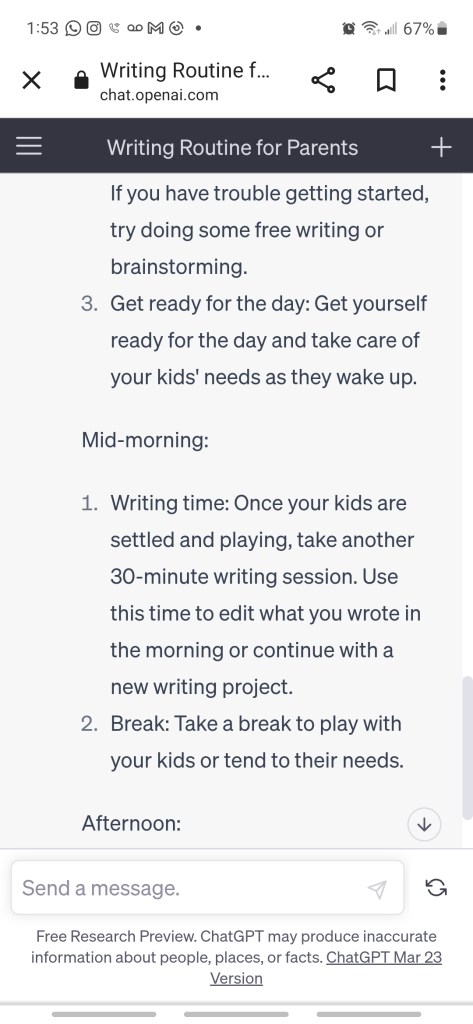
Basically what Chat GPT came back with was a writing routine where you do thirty minute sessions throughout the day in between caring for your kids. One before they wake up, a mid morning session while they “play quietly”, an afternoon session while they nap or have “quiet time” and an evening session after your kids go to bed.

Seems feasible, but at the same time they’re little kids. Nothing is feasible hahaha.

At the end of the writing routine, the AI told me to be flexible and it’s okay to adjust as necessary. I responded back a thank you and also asked it to please remember me if it ever takes over the world. To which it said this:

Concerning. That little wink. Is that a threat? I can’t tell.

So the next day I set an alarm for an hour earlier than my kids usually get up and got to work. And of course, my four-year-old woke up an hour earlier than he usually wakes up. (How did he know?) I wrote anyway and was okay productive. I did have to stop once or twice because my son asked me to open his yellow popsicle at 6:30 in the morning.

Gosh I hope he naps today.

Mid Morning session turned out to be later than I thought but worked fine. I settled my four year old with Blippi on my phone and gave the baby her favorite puffs in her high chair. I had only gotten a couple of minutes in when my son wanted to play “ghost” with me, so I had to get him a sticker book to entertain him. Then I found myself immediately texting my husband about work and dang. The morning session sure was easier. Sad for me because I don’t like getting up early. But also had I followed Chat GPT’s advice and done a mid-morning session while my baby was asleep instead of almost falling asleep myself I would have been more productive altogether. Oh well. Plan for exhaustion if you’re a parent. Just pencil it into your schedule.

Afternoon session I opted to try to squeeze in while waiting to pick up my son from school. I usually get in the pick up line super early so I thought it would be a nice natural break to try it out. I also slowly drove around the neighborhood so the four year old who woke up ridiculously early would pass out. He did. But then the baby was complaining of course. I brought extra toys. All of which were really loud, so that was dumb of me. I wrote as best as I could in the awkward, hot car. It was okay. So far I had a total of 1400 words by the time I had done the three half hour sessions, so honestly that wasn’t too bad!

During the evening session I put up this blog post. So you’re welcome haha.

GUEST POST: “Just Start” Annie Cowden


JUST START PLEASE!

Hey, you creative geniuses!! You have so many ideas just swirling through your head constantly. So, I bet you can relate to some of these phrases you have when it comes to thinking about making that vision come to life.

Does this sound familiar?

• Once I am more clear, THEN I will start!
• I’m just waiting until I have a little more clarity
• I don’t know what I want yet, so I’m just waiting
• I’m trying to figure out what it is EXACTLY I’m meant to do before I do anything

HOMIES!! I got to tell you something. And that is, this type of thinking can become habitual thinking and it is a straight up trap. As long as you keep thinking that way….no big surprise here — you’re going to keep thinking that way. Waiting leads to more waiting, period. If you wait to decide on one thing, you’ll wait to decide the next thing. And then you will comfort yourself by saying ah I’ll wait till the next go around. I’ll wait till things aren’t so crazy in my life. I’ll wait until ____________________.

There is one small (large) problem with that.

The TRUTH is, is there are not very many guarantees. So you’re betting on something that you don’t know and you can’t know is going to happen. Think about it: Are you waiting to start writing until you have the dream writing office with natural light and a fountain and no kids screaming in the background. Or maybe you’re waiting until you have more free time. (that seems kind of vague to me no offense, but I hear that one all the time).

TODAY IS ALWAYS THE DAY. Today is the day to do something towards getting your creative project off the ground. Because here is the punchline:

“Clarity doesn’t come before action, action comes before clarity”

Now hold up- I understand how this could be confusing when there is so much advice on being specific about your audience, your message, your mission statement, who you are, what you do, etc. But YOU GUYS stop taking labels so seriously. There are not rules in life. You can change your bio and your title whenever you want. You can change it twice a day if you want! You can self designate yourself whatever you want, at any time, without having to ask a soul.


Here’s Why You Have to Take Action Before Clarity:


When I say take action, I mean- what logistically and literally has to happen in order to make this happen. Who has to be contacted? What do you have to create? What physical things do you need ready?

Now ask yourself, “what is the quickest way to get this done”. Because there’s a whole lot of mojo that goes into getting a book published, recording a song, starting a business, etc. But many people start with the fluff instead of start with the juicy stuff. It’s like you’re spending all your time on the whipped cream and keep procrastinating making the pie which is what you really love doing and what you do best.

So, before I get a song recorded, I have procrastinated because of a gazillion of reasons, but I can sum them up like this:

• The song isn’t good enough yet
• I don’t know anyone who will record the guitar part for me
• I can’t afford it
• I’m waiting until I can find backup singers

Just some typical fluff. Which I know you can see similarities amongst any craft. Here’s the truth though-all of these “excuses” or “obstacles” are either A) Not true or B) can be overcome by taking action on that specific task.

So if the true, ONLY THING STOPPING me is “I can’t afford it”, if that is really honestly and sincerely the truth, then my only focus from that point on becomes getting creative to get the money. My new task at hand is to earn the money. If you will truly do anything for your craft, then these excuses don’t matter. I immediately dig into my skill sets and think what I can offer, sell clothes, reach out to people who need a dog walker or a babysitter, have a yard sale, skip out on a cost I normally buy (sacrifice something else). Because believe me, it’s possible if you want it.
Similarily if my excuse is “I don’t have backup singers yet” or “I don’t know anyone who can play a guitar” then I just need to stop whining about it and say: Okay, well what would an established professional who was looking for a musician do? Journal out all the possible solutions to your problems, and one of them will land home with you. Try one of them or try all of them.

You Are Allowed to Change Your Mind


Changing your mind does not mean giving up. I always want you to be honest with yourself. If you truly deeply desired to run a 10K but after 2 weeks had a few bad days and gave up, that’s not the same thing as changing your mind. But if you showed up your best self, made a promise to yourself to follow a training schedule, gave it enough time to give yourself the chance to form a new habit, then you will be opened up and exposed to more avenues of things you love more.

Maybe you stick to the training plan, and because of that you see a class at the gym which ends up bringing you WAY MORE JOY than running. If you wind up choosing the class over training, it isn’t necessarily giving up. However, it’s all about your initial intention anyway. You have to be honest about why you wanted to do the race.
-why you wanted to write the book
-why you wanted to start the non-profit
-why you wanted to be a teacher
-why you wanted to be in the show

Knowing your why will keep you going. So don’t skip taking the time to know your why!

The reason why action brings clarity, is because you are likely doing something you have never done before. So how in the world are you supposed to know exactly what to say, do, wear, when you have not done something before?!?? Sometimes I have ideas for camps/workshops for various musical theatre camps and voice lesson programs, but I avoid going to edit and finalize the flyer because “I don’t know for sure what I am offering”.

Guess what: as long as my flyer stays as a draft on my laptop, then I’m not sharing my musical passion with anyone, nobody’s kids are getting my joy and energizing classes, I’m not getting any money from my gifts, ALL BECAUSE I AM WAITING TO COME UP WITH THE PERFECT IDEA.

So to sum this up, in my case taking action can be WORKING ON THE FLYER. Maybe my very first day I don’t have to print it and hang it up, but every day I work on the flyer, the idea change a little bit. The time length of the workshop changes, the price changes, the concept changes, and the more I work on it, the closer and closer it gets to feeling like home. But I know well enough that there is no such thing as perfect, so once it hits a place that feels good and exciting in my body, I then have to take the action to print out the flyers and hang them up. And no, I don’t know all the logistics, but I will know as I go along.

To writers: When you are writing, you are not writing in permanent marker on something that is going to be hung in a museum with your name on it. You literally can change it, always. But NEVER save a good idea for later. That is the worst thing a creative can do. Because then you are essentially believing you won’t get any better ideas. Do you know how many amazing chord progressions that have come to me that I didn’t make a song with because I was waiting until I was a “better songwriter” to use them? That sounds so silly now!

The next time you feel that dark cloud come over you when you are about to begin a project, say this affirmation:

I have unlimited permission to change this as many times as I want.

We are so weird as humans. We always need permission don’t we? Sometimes just acknowledging that whatever you create isn’t permanent, is so liberating.

ALSO.

It’s very liberating to understand that, so long as you aren’t breaking laws…you really can’t screw up your path that much. We spend a lot of mental energy making decisions because we want to be “right”. Here’s a secret…one decision you make isn’t really going to alter your destiny. If you want to try doing slam poetry, well you might as well try it because we only got like 99 years on this earth so just keep doing you. When in doubt, just bring it back to the now, and ask what excites you most? ALWAYS follow the joy. Always follow the fun.

I am going to leave you with one book recommendation and one song recommendation!

Book: The War of Art by Steven Pressfield.
Song: Follow the Compass of Your Heart https://www.youtube.com/watch?v=BY5JTxFt2pM


Annie


ANNIE COWDEN is a singer, songwriter and motivational speaker. When she’s not traveling the world, she works with teens and young adults who feel deeply inspired to create amazing things in their life. She is a self-discovery leader, adventure-seeking heart follower, and music is her first language. If you would like to learn more about her coaching, please follow her wonderful page on Facebook- https://www.facebook.com/AnniesVizion/