Monthly Writing Challenges

Several months ago I had this funny epiphany… I really like writing challenges. Challenges are really effective for me for some reason. Things like National Novel Writing Month and when I did weeklong goals for the new year. I don’t know if it’s because of the natural deadline that comes with it or it’s a good burst of dopamine when I win. I’m not a competitive person AT ALL. But I guess with myself I am? I don’t know.

So I thought, hey. I really should use this to further my writing. Just as an extra motivation. And I also noticed that month long challenges were really the most beneficial to myself. It’s a long enough time to get a serious amount done, but not so long that I get bored and want to give up.

And that’s how I came up with an annual schedule that I’m really REALLY excited about! I started piloting it last year and so far it’s going really well! Here are my challenges for each month, if you’re looking for motivation for yourself as well!

JANUARY – “Januwrimo” or “NaNoFinMo”

Kind of funny to start with the end, but I think it’s important. During the traditional NaNo, 50k typically doesn’t finish a standard novel, which is more around 80k. So, I would love to go ahead and do that after the holidays. Kick off the year with a 30k challenge and a finished draft. Um, yes please!

FEBRUARY – “Flash February”

It’s a short month for some short fiction! I have a bunch of short stories floating around in my mind and this is a perfect time to get those out. I could either chose to do something similar to The Ray Bradbury challenge (write one short story a week) or I could opt to comprise poems or flash fiction as well.

MARCH – “Spring Edit Blitz”  

Rather than a word goal, this could be a time goal, or a “to-do list of goals” centralized SOLELY on editing. This could be re-working an outline, writing a second or third draft, line edits. Anything.

APRIL & MAY – “Camp NaNoWriMo” / “NaNoSloMo”

“NaNoSloMo” is a challenge that I invented. It’s basically taking the traditional NaNo challenge, but instead of 50k in a single month, you give yourself two months to finish 50k. (25,000 words per month). As I mentioned earlier, I know the one-month challenge is very effective for me because I don’t get “bored” knowing that I change goals at the end of the month. So even though I like the idea of NaNoSloMo, I’m nervous to see how it might go for me this year.  

JUNE – “Summer Break”

In June, I take a break off of writing and focus solely on reading.

JULY – NaNoFreeMo

I’ve been doing this for a few years now and I love it. Every July for Camp NaNo I do a NaNoFreeMo (another NaNo challenge I made up). I set an achievable but challenging word goal (usually 20-40k) BUT I can write whatever I want. There are no rules. I can journal. I can write random scenes from projects that I haven’t even started. I can write ‘bla, bla, bla, bla’ a hundred times if I want to. It’s a total free for all based on how I happen to feel that day. No thinking of publishing, readers, industry trends, NONE OF IT. No one ever has to read what you write during NaNoFreeMo. I can write whatever thing I want to during July. And it’s so great.

AUGUST – “Summer Edit Blitz”

Back to the grind. Same as the spring edit blitz. Trying to get things ready for the following month.

SEPTEMBER – “Sendtember”

This is the month where I start submitting things. Usually, it’s a good month for agents and such as they’re also coming back from their summer breaks. I don’t have to send to lit agents though. I can send short stories or articles WHATEVER. But I must send something. Or as much as I have ready during the month of September.

OCTOBER – “Preptober”

Prepping for NaNo, obviously. But doesn’t have to be that exclusively. I think it would be really great to have a few outlines prepared for the following year if possible. And if that’s not really possible, I also feel like this is a good time to prep for Holidays as well as writing.

NOVEMBER – “NaNoWriMo”

National Novel Writing Month. 50k words in the month of November. I highly recommend this if you are just now stumbling onto monthly challenges or are looking for a way to further your book. It’s just a whole lot of fun!

DECEMBER – “Winter Break”

I’ve worked hard all year. It’s time for another writing break (with reading assignments).

When I had all the challenges written out, I sat back, looked at it and… felt GREAT. Like if a boss had handed me this annual work schedule, I would feel that boss was being very reasonable and kind but also productive. I was my best own boss!

If you end up trying any of these or have any other tips and ideas for months, please leave a comment as I would be really curious to see what other authors do as well!

How to Lengthen and Structure Scenes: The Rainbow Technique

I am a terrible underwriter. I would spend months planning a novel only to have it come out to thirty thousand words. EVERY SINGLE TIME. One time as part of a writing conference I had an industry professional examine my work and they gave me 10/10 for voice… 2/10 for pacing. Yeah, I mean, not surprising. I write like the impatient level 5 tornado that I am. So I did a lot of soul searching. Spoke to my higher self. And this technique popped into my mind like the godsend that it was.

And I am going to share it with you, dear writer. Because this has absolutely saved my writing life.

I call it “The Rainbow Technique”. And it’s a way to structure individual scenes.

The idea of The Rainbow Technique is that you can structure an individual scene using the seven colors of the rainbow. First, you figure out your three primary colors. Which would be the three major components of a scene: The set-up, the conflict and the resolution. (If you prefer, you can think of it in Dwight V. Swain’s phrasing, “goal, conflict, disaster”.) For the sake of this technique and rainbow imagery, the three parts of a scene are assigned these colors:

Red – The set-up (the character’s goal)

Yellow – The conflict

Blue – The resolution (or disaster)

But of course, those aren’t the only colors of a rainbow. There are colors in between. For whatever reason, this is the imagery that helped me to appropriately slow down my scenes. You need red, yellow, blue but you also have orange, green and purple. Just as you need a set-up, conflict and resolution, you also need moments in between that transition and build.

So therefore, “a rainbow structure” could look something like this:

Red – The set-up

Orange – Lead up to the conflict

Yellow – The conflict

Green – Lead up to the resolution

Blue – The resolution

Indigo – Character’s emotional reaction

Violet – Character makes a plan for the next scene

Note that the scene doesn’t end at the resolution. It’s a resolution of the conflict but the character still needs to react and act to whatever happened. This is called “a sequence” and it’s very helpful to readers to connect with your character.

The idea of “lead ups” might be kind of weird to grasp at first, so I’ll give you an example of how to use this technique to rewrite a scene that’s too short.

A skimpy scene I might write could be something along the lines of:

Sir Gallant arrived with his men to the castle and knocked on the door. Suddenly, an enormous red dragon burst through the wood, sending shards flying around Sir Gallant’s men. “Retreat!” someone cried as a stream of roaring fire blew through the dragon’s mouth. The knights mounted their bucking horses and retreated to the hills. The men sought shelter in a cave. “We will have to figure another way in,” Sir Gallant said panting and wiping his brow.

Okay let’s take that scene and expand on it using the rainbow technique.

So, first we’re going to have a set up (RED).

In the skimpy version my set up is “Sir Gallant arrived with his men…” But how did they arrive? What did they look like as they arrived? What did the horses’ hoofs sound like? Was the ground muddy or rocky? The set up is all about painting the scene and tone. Take time here to give us as many sensory details as you can.

Next, we’ll have a lead up to the conflict. We’re not having the conflict yet, we’re just going to allude or foreshadow the fact that we are about to face some conflict (ORANGE).

I always first draft my conflict into this Hollywood jump scare. AND THEN THE DRAGON BURST THROUGH THE DOOR KABOOOOM! AND THEN SUDDENLY HE LOST CONTROL AND YELLED AT HER.  Buuuut. These moments are much much more impactful if you build tension and alert the readers that the goal might not be accomplished. For example, let’s say that when Sir Gallant arrives at the castle, they don’t knock on the door right away. Let’s write that it’s eerily quiet. Maybe the horses act nervous and stop. And then there’s a dialogue between Sir Gallant and his right-hand man, wondering why there’s no one manning the gate. Maybe they notice there isn’t a single voice to be heard. Not even bird song. With “ORANGE” we’re basically cueing the audience that something is wrong. We’re about to be met with a problem.  

Now, the real conflict (YELLOW)

The dragon bursts through. Details, details, details! In all your “primary color” segments you must add lots of sensory details. Hollow knock on the tall castle door. Wispy white smoke billowing from the crack underneath. Not just what the dragon looks like, but what he smells like. What his roar sounds like.

We’re not going to have a resolution right away. We’re going to do the same that we did before and bridge the two elements together. This character WANTS this goal. They will FIGHT this conflict. Show that they want it, don’t let them accept defeat so easily. (GREEN)

In the skimpy version we had the men retreating pretty quickly. But in this edited version, Sir Galland is not going to allow that to happen right away. We’re going to have ‘Stand your ground, men!’ and the sound of swords clanging. Certainly, we’re going to have some minor characters killed in this moment. Maybe a young man that Sir Galland had interacted with earlier. Either way, this is going to take a LOT to get him to back down. It’s going to take his right-hand-man pleading and begging him to retreat before he leaves.

Then they are forced to accept the resolution (BLUE)

Back through the woods and to the caves. You can mirror this section with the “red section” to showcase the change. Are the horses hoofs softer now that there are fewer? Is the once dry and rocky forest now smoldering and raining ash?

Now we’re not done quite yet! The character has to have a reaction and show how this resolution has affected them! (INDIGO)

We need a moment for Sir Galland to angrily throw his helmet onto the ground. Or quietly ask his right hand man “How many were lost?”. This all depends on your individual character and how this particular conflict would feel for them.

Then what is the plan? What is the hint for the next scene? If we see this proactive character formulating a plan it will keep us turning the page to see if they do indeed get this goal! (VIOLET)

Sir Galland gathers his men and explains they can no longer get into the castle through the gate or over the walls, so they’ll have to make a plan to go under the dragon. Then he asks his right-hand man where they can get shovels.

That is just a quick example of what I’ve been doing, but it’s been really effective! I personally give myself a word minimum of 300 for each color. That has extended each of my “scenes” into 2,000+ words a piece. Which makes them better suited for chapters. It works the best for me, because my previous drafting of 30k word novellas can easily be turned into appropriate length novels without having to add major changes to the plot or subplots. (Usually)

This technique helps with both plotting or editing. If you do give it a go, please let me know. I would be curious if this helps other underwriters!

I Asked AI to Give Me a Writing Routine as a STAHM

One of my very favorite author tubers is Kate Cavanaugh because she always tries the most interesting writing challenges. And the one that I watched recently was where she asked AI to give her a “crazy” writing routine. Which it definitely delivered. It told her to get up at three or something and eat a handful of chocolate chips for breakfast hahaha.

So I was certainly curious about this. Obviously, I wasn’t going to try to ask it for “something crazy” like Kate did. I am a stay at home mom with three kids. Ages 6, 4 and 1. So when it comes to writing routines… I have to have a regular babysitter or else there just is no routine at all. And that was something that Kate doesn’t have to work around, so I thought I would ask the all-knowing AI and see what kind of advice it would give to a stay at home writer person such as myself.

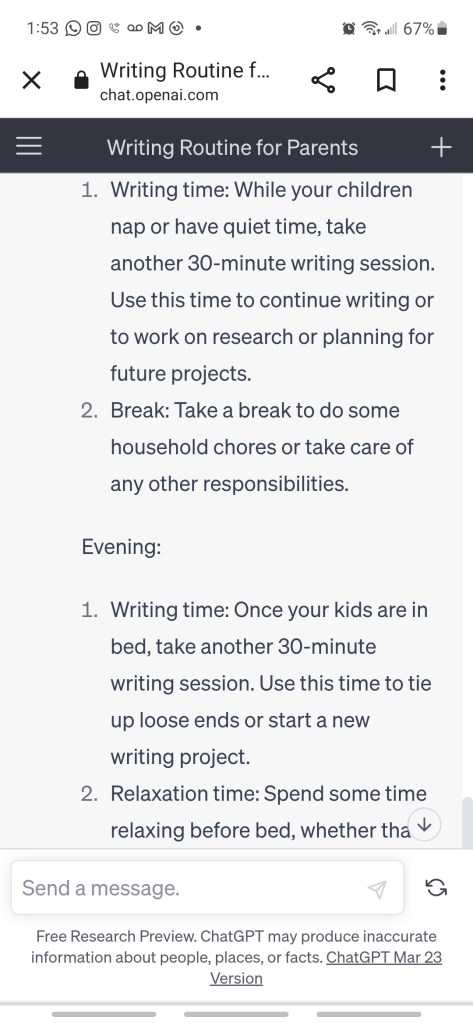
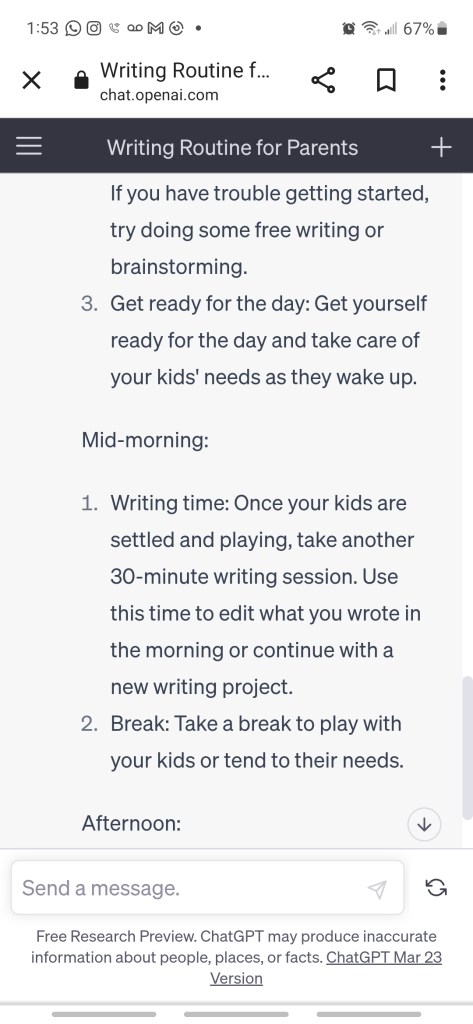
Basically what Chat GPT came back with was a writing routine where you do thirty minute sessions throughout the day in between caring for your kids. One before they wake up, a mid morning session while they “play quietly”, an afternoon session while they nap or have “quiet time” and an evening session after your kids go to bed.

Seems feasible, but at the same time they’re little kids. Nothing is feasible hahaha.

At the end of the writing routine, the AI told me to be flexible and it’s okay to adjust as necessary. I responded back a thank you and also asked it to please remember me if it ever takes over the world. To which it said this:

Concerning. That little wink. Is that a threat? I can’t tell.

So the next day I set an alarm for an hour earlier than my kids usually get up and got to work. And of course, my four-year-old woke up an hour earlier than he usually wakes up. (How did he know?) I wrote anyway and was okay productive. I did have to stop once or twice because my son asked me to open his yellow popsicle at 6:30 in the morning.

Gosh I hope he naps today.

Mid Morning session turned out to be later than I thought but worked fine. I settled my four year old with Blippi on my phone and gave the baby her favorite puffs in her high chair. I had only gotten a couple of minutes in when my son wanted to play “ghost” with me, so I had to get him a sticker book to entertain him. Then I found myself immediately texting my husband about work and dang. The morning session sure was easier. Sad for me because I don’t like getting up early. But also had I followed Chat GPT’s advice and done a mid-morning session while my baby was asleep instead of almost falling asleep myself I would have been more productive altogether. Oh well. Plan for exhaustion if you’re a parent. Just pencil it into your schedule.

Afternoon session I opted to try to squeeze in while waiting to pick up my son from school. I usually get in the pick up line super early so I thought it would be a nice natural break to try it out. I also slowly drove around the neighborhood so the four year old who woke up ridiculously early would pass out. He did. But then the baby was complaining of course. I brought extra toys. All of which were really loud, so that was dumb of me. I wrote as best as I could in the awkward, hot car. It was okay. So far I had a total of 1400 words by the time I had done the three half hour sessions, so honestly that wasn’t too bad!

During the evening session I put up this blog post. So you’re welcome haha.